Last Updated: November 12, 2026
Quick Summary
Custom cabinetry adds value because it is built to the room it occupies, not to a warehouse shelf, supporting appraisal credit, buyer perception, and marketability. According to Kitchen Cabinet Kings’ 2026 report, a kitchen project returns an estimated $32,141 in resale value, recouping 112.9% of project cost. That figure covers the whole kitchen, not cabinets alone.
- Custom cabinets and home value connect at resale through appraisal credit, buyer perception, and marketability against comparable listings.
- Stock cabinets come in fixed widths, so installers often fill leftover inches with filler strips, leaving dead space.
- Plywood construction generally holds up better than particle board in rooms with moisture and daily traffic.
- Custom cabinetry stops paying back when the specification outruns the house and its comparables.
- Appraisers rate cabinetry as part of the kitchen’s overall condition and quality, not as a separate line item.
Table of Contents
- Why Custom Cabinetry Adds Value: What the Numbers Say
- How Custom Cabinets and Home Value Connect at Resale
- Custom vs. Stock Cabinets: Where the Value Gap Comes From
- What Custom Cabinet Cost Really Buys You
- RTA Cabinets and the Budget Alternative
- The Diminishing Returns Threshold: When Custom Stops Paying Back
- Appraiser Perspectives, Maintenance, and the Full Lifecycle
- Planning a Custom Kitchen That Pays You Back
- Frequently Asked Questions
Why Custom Cabinetry Adds Value: What the Numbers Say
Custom cabinetry adds value because it is built to the room it occupies, not to a warehouse shelf. According to Kitchen Cabinet Kings’ 2026 Kitchen ROI & Cabinet Trends Report, a kitchen project returns an estimated $32,141 in resale value, recouping 112.9% of project cost. That figure covers the whole kitchen, not cabinets alone, but it explains why we at Capitol Design treat the cabinet plan as the financial spine of a remodel. Below, we break down where the value actually comes from, where it stops paying back, and how to tell the difference before you sign.
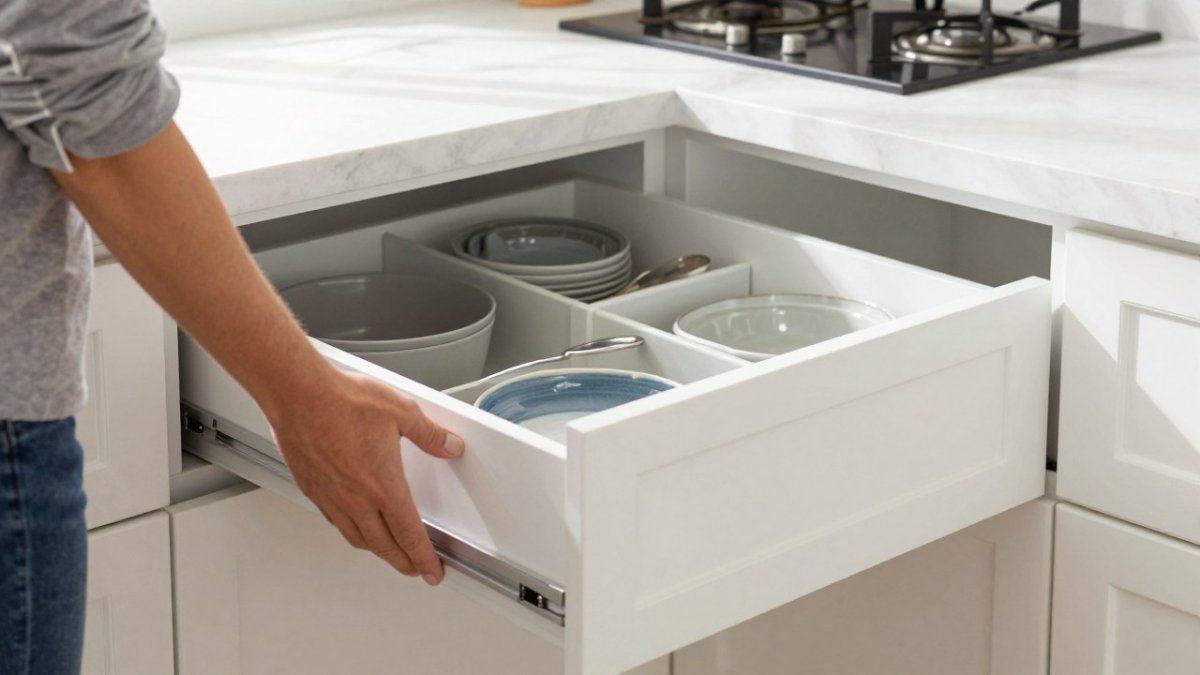
Specialty storage features such as full-extension drawers and corner solutions are a common source of everyday usability in updated kitchens. That is the quiet engine behind the numbers: drawers that pull out fully, dividers that stop a stack of pans from collapsing, and corners that stop swallowing space. Buyers do not pay for “custom.” They pay for a kitchen that works the moment they open a door.
How Custom Cabinets and Home Value Connect at Resale
Custom cabinets and home value connect at resale through three channels: appraisal credit, buyer perception, and marketability against comparable listings. None of the three is automatic, and all three reward the same thing, which is a kitchen that looks and functions as if it belongs to the house.
Appraisers work from comparables. A kitchen with bespoke design and a coherent finish package supports a higher comparable tier, while a kitchen with mismatched boxes and gaps at the wall does not. Buyers, meanwhile, walk in and open things. Soft-close hardware, dovetail joints, and drawers that glide tell them the house was maintained by someone who cared. That impression is worth real money in a negotiation, and it is the reason property appeal and cabinetry durability show up in the same conversation.
Kitchenique Cabinetry’s guidance on custom sizing points out that custom dimensions address irregular rooms and recover otherwise unused storage. In older homes, that recovery is often the single biggest functional gain in the project.
Custom vs. Stock Cabinets: Where the Value Gap Comes From
The gap between custom vs. stock cabinets is not decorative. It is structural, and it shows up in four places: the box, the drawer, the fit, and the hardware. Each one is something a buyer or an appraiser can see, touch, or open in under a minute, which is why the gap translates into dollars rather than just preference.
Stock cabinets come in fixed widths, so installers often fill leftover inches with filler strips, which can leave dead space beside the refrigerator and corners that are hard to reach. Semi-custom cabinets offer a limited size menu that sits between stock and fully custom.
Construction and Materials That Hold Up
Plywood construction generally holds up better than particle board in rooms with moisture and daily traffic, since particle board can swell when water reaches its core. Plywood holds its dimensions well and handles repeated fastening and heavy loads. Many cabinet makers publish their material specifications, and asking about them is worth doing before you compare bids.
Joinery matters just as much. Joinery matters for durability: dovetail drawer boxes are mechanically locked together, while stapled or doweled boxes rely more on glue and friction. A homeowner can often check the drawer joinery by pulling the drawer out and looking at the corner. If you are weighing materials for a custom kitchen, our guide to choosing materials for your custom kitchen walks through the trade-offs.
When comparing bids, ask for the drawer-box material and joinery method in writing, since a plywood-face description alone does not always show what is inside.
Storage Efficiency and Layout Fit
Storage efficiency is one of the main benefits of custom cabinetry in daily use. A well-planned kitchen assigns a zone to each task, such as prep, cooking, cleaning, and storage, and custom dimensions let the cabinet plan follow that logic. Common solutions include pull-outs beside the range, tall cabinets with adjustable shelving, and corner units that reduce dead space. A drawer bank sized to the plates and bowls you actually own beats a cabinet with one fixed shelf and a pile of unused air above it.
Space use is not a luxury feature. It is the difference between a kitchen that photographs well and a kitchen that cooks well, and it is the part of the value equation a buyer feels immediately on a showing. When a stock layout forces filler strips and dead corners, the buyer sees wasted square footage in the most-used room in the house; when a custom layout recovers that space, the buyer sees a kitchen that fits the home.
What Custom Cabinet Cost Really Buys You
Custom cabinet cost buys three things stock cannot: exact fit, material control, and a service relationship that survives the install. Custom cabinet pricing reflects shop labor as well as materials, which is one reason quotes can vary between firms. Because material choices and workmanship shape how well cabinetry serves a space over time, Wish Interiors connects those decisions to the standards that guide a lasting installation.
Because pricing depends on dimensions, door style, finish, and hardware selection, any honest number requires a plan. Current pricing is available on the Capitol Design website, and comparing quotes on specification rather than on the bottom line alone is a useful approach. A low bid with particle board boxes and stapled drawers is not the same product as a bid with plywood and dovetails, even when the totals look close.
For a full picture of where the money goes across an entire project, our luxury kitchen renovation cost breakdown guide benchmarks cabinetry against countertops, appliances, and labor.
RTA Cabinets and the Budget Alternative
RTA cabinets arrive flat-packed and assemble on site, and they generally cost less than custom options. For a secondary property or a kitchen you plan to replace in a decade, that math can work.
The trade-offs are real. Assembly quality depends on the installer, sizes come from a fixed catalog, and the finish options rarely reach the depth of a shop-applied custom finish. RTA cabinets also tend to stop at the standard depth and height increments, which brings back the filler strips and the dead corners. Choose RTA when budget is the governing constraint. Choose custom when the room is irregular, the house is high-value, or you intend to stay.
| Option | Fit to Room | Material Control | Best For |
|---|---|---|---|
| Stock | Fixed sizes, filler strips | Limited | Tight budgets, standard layouts |
| Semi-custom | Size menu, some flexibility | Moderate | Straightforward remodels |
| RTA | Catalog sizes, on-site assembly | Limited | Rentals, flips, short timelines |
| Custom | Built to dimensions | Full | Irregular rooms, luxury homes |
The Diminishing Returns Threshold: When Custom Stops Paying Back
Custom cabinetry stops paying back when the specification outruns the house. A very high-cost kitchen in a neighborhood of more modestly priced homes may not return its full cost at resale, regardless of construction quality. Hand & J Cabinets’ analysis of custom cabinet value makes a related point about the luxury market: quality cabinetry is table stakes there, and its absence may devalue a home more than its presence adds value. In that tier, you are not buying an upgrade.
The threshold is set by your comparables, not your taste. Look at what the three closest recently sold homes have in their kitchens. Match the top of that range, and stop. Some homeowners do regret overspending on cabinetry, so it is worth weighing the other side of the argument before you commit. Homeowners who regret the spend usually overshot their neighborhood, not their cabinet quality. If you are worried about overspending, our breakdown of kitchen remodel mistakes that cost homeowners thousands covers the expensive ones.
Appraiser Perspectives, Maintenance, and the Full Lifecycle
Most articles stop at “it adds value.” The more useful question is how a professional appraiser actually gets there, because the appraisal is where cabinetry quality either shows up in the number or does not.
Appraisers do not itemize your cabinetry line by line. They work from the sales comparison approach: they find three to six recently sold homes of similar size, age, and location, then adjust the subject property up or down for differences.
Maintenance and lifecycle costs belong in the same calculation, and this is where the financial case gets practical. Shop-finished cabinetry can be more consistent than site-finished work because the coating cures in a controlled environment, and soft-close hardware reduces the wear that comes from slamming doors.
Sustainability fits here too. Durable cabinetry supports sustainability, since a cabinet that lasts is one that does not need replacing. Ask suppliers about low-emission finishes and responsibly sourced wood, and treat longevity as the primary environmental metric. Ask suppliers about the specific finish systems and wood sources they use.
Planning a Custom Kitchen That Pays You Back
Start with the room, not the catalog. Measure the irregular walls, note where the light falls, and decide which tasks the kitchen must serve before anyone draws a door style. Then set your budget against your comparables, not against a magazine spread. The homeowners who come out ahead are the ones who spent on fit and function first and finish second.
At Capitol Design, we have over 35 years of experience designing custom kitchens and baths. If you want the deeper resale playbook, read our guide to maximizing kitchen resale value, and when you are ready to talk through your space, contact us about your custom kitchen project.
The difference between a kitchen that returns its cost and one that does not usually comes down to planning discipline. We match the specification to the house, the neighborhood, and the way you actually cook, then build it with plywood boxes, dovetail drawers, and soft-close hardware that hold up for decades.
Frequently Asked Questions
Are custom cabinets worth the money?
It depends on the home and the buyer. Kitchen projects can add to resale value, though the gain depends on the whole kitchen rather than cabinetry alone. Custom cabinetry pays back best when craftsmanship, storage efficiency, and finish quality match what buyers in your price bracket already expect. In a luxury market, quality cabinetry is often a baseline expectation rather than an upgrade.
Do custom cabinets improve resale value?
They can, but the gain is rarely cabinetry alone. Custom cabinets and home value connect through property appeal: a fitted kitchen with dovetail joints, plywood construction, and soft-close hardware reads as well-maintained to buyers. Appraisers weigh the kitchen against comparable homes, so the return depends on your local market. If neighboring homes already have upgraded kitchens, custom cabinetry keeps you competitive rather than pushing you ahead.
What is the difference between custom and stock cabinets?
Stock cabinets come in fixed sizes and standard finishes, so installers fill gaps with filler strips. Custom cabinets are built to your room’s exact dimensions, which recovers storage in irregular or oddly shaped spaces and allows bespoke design details. The custom vs. stock cabinets decision usually comes down to fit and longevity: custom units are often built with heavier construction and higher-grade hardware, while stock and RTA options generally cost less upfront.
How much do custom kitchen cabinets cost?
Custom cabinet cost varies widely with size, materials, hardware, and finish, so there is no single figure. Expect custom to run higher than stock or RTA cabinets, which trade exact fit and material quality for a lower price. The better question is what the money buys: dovetail joints, plywood construction, specialty storage, and a finish that lasts. Get a project-specific quote rather than relying on averages.
